How big is the answer?
Published:
Here’s a question that sounds trivial and isn’t: when you solve an ARC task, how big is the output grid?
For a lot of tasks the output is the same size as the input, and you never think about it. But of the 1,000 ARC-AGI training tasks, 320 change the grid size. Before you can draw the answer, you have to know its shape — and for these 320, that’s its own little puzzle.
So I tried to pin it down with rules. I wrote out the cases I could think of for how an output size gets determined:
case 1 : the size difference is constant across all pairs
         1-a : output is N× the input
         1-b : output is 1/N× the input
case 2 : output is always a fixed size
case 3 : output size = the size of some object in the input
case 4 : output size comes from a property of an object/grid
case 5 : computing the size takes several steps
Then I counted. Cases 1 and 2 — the easy, “just look at the ratio” ones — cover 182 of the 320. Case 3, where the answer’s size is borrowed from an object already sitting in the input, matches 163 tasks (73 of them only by case 3). After cases 1–3, 63 tasks still fall through.
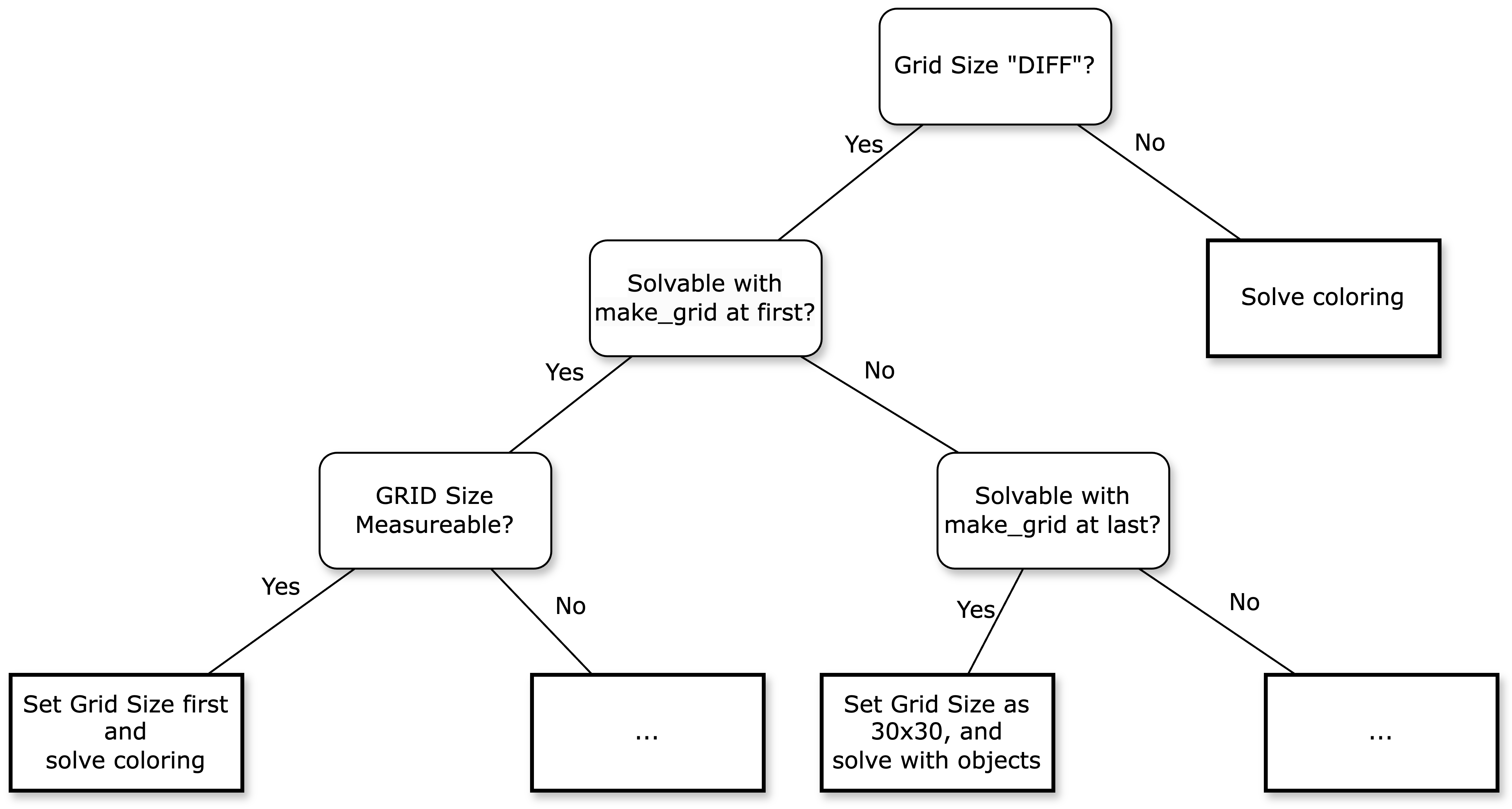 The branching I ended up with — first ask whether the size even changes, then whether it’s measurable directly, then fall back to objects.
I went through those 63 by hand, and they’re where it gets interesting. Almost none of them give you the size. You have to compute it:
- count the rectangular objects, and that count is a dimension;
- take an object’s height
hand widthw, and the answer is2w + h; - the side is the number of non-background colors, times the input width;
- and a recurring one — the output is always a square, which you can only exploit once you’ve noticed it.
The thing I took away: “how big is the answer” is almost never handed to you. It’s a small reasoning problem of its own — a computation over what you observe, like object sizes and color counts. If a solver can’t measure and do arithmetic on what it sees, it can’t even get to the starting line for a third of the size-changing tasks. Determining the canvas is already part of solving the puzzle.
