Humans learn by comparing
Published:
This is the first of a few short notes I’m posting from my research notebook — older thoughts, lightly cleaned up, that trace how I got to where I am now.
A question I keep coming back to: how do humans learn a new concept? Where does it start?
The answer I keep landing on is almost embarrassingly simple. It starts from comparison — from putting two things side by side and noticing what is the same and what is different.
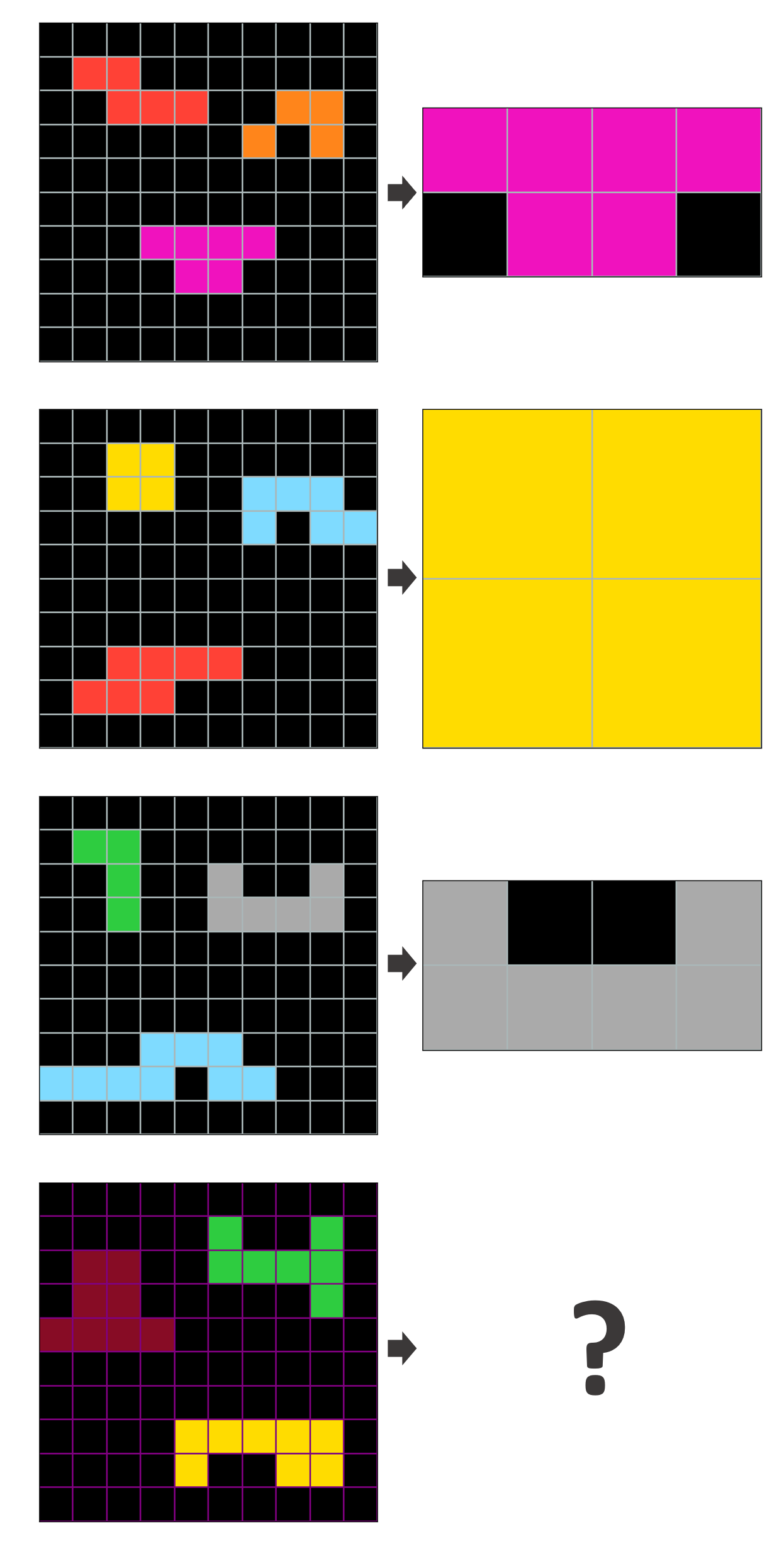 A single ARC task. You’re given a few input→output pairs and one test input. To find the rule, you do exactly one thing first: you compare.
Take an ARC task. You look at the input grid, then the output grid, and then — without being told to — you compare them.
- Some pixels changed color. → that’s a difference.
- Some pixels stayed in the same place. → that’s a commonality.
- The grid size is unchanged, the background is still black. → more commonalities.
That’s it. That’s how we start finding the rule. And here’s the part I find interesting: you don’t even need two grids. You can do it with one.
Look at a single grid with a red pixel sitting in a field of black. Why do you see the red pixel as a thing? Because of the difference between it and its neighbors — a color boundary. (Even human infants segment the world this way: they find boundaries first.) And when you notice that the yellow pixels all sit one diagonal step from the red one — that’s a commonality you just discovered between them.
So my working picture of concept formation is roughly:
- Notice the differences first — they’re what catch the eye.
- Find a commonality that connects them.
- Name it — formulate the discovery as a concept.
- Verify it later, by repetition, by finding the same commonality again.
And if something new shows up that doesn’t fit anything you have — you just define it as its own concept, and wait to confirm it on a later example.
I don’t think any of this is special to ARC. It’s how I learned the alphabet (a teacher put twenty-six shapes on a board and I started telling them apart), how I learned a second language, how anyone learns a new piece of mathematics. We understand complicated concepts through examples precisely because examples are things you can compare.
If that’s right, then “comparison” isn’t a preprocessing step before the real reasoning. It might be the real reasoning — and a system that wants to learn like a human should probably be built around it. That’s a thread I’ve been pulling on ever since.
